01Situation
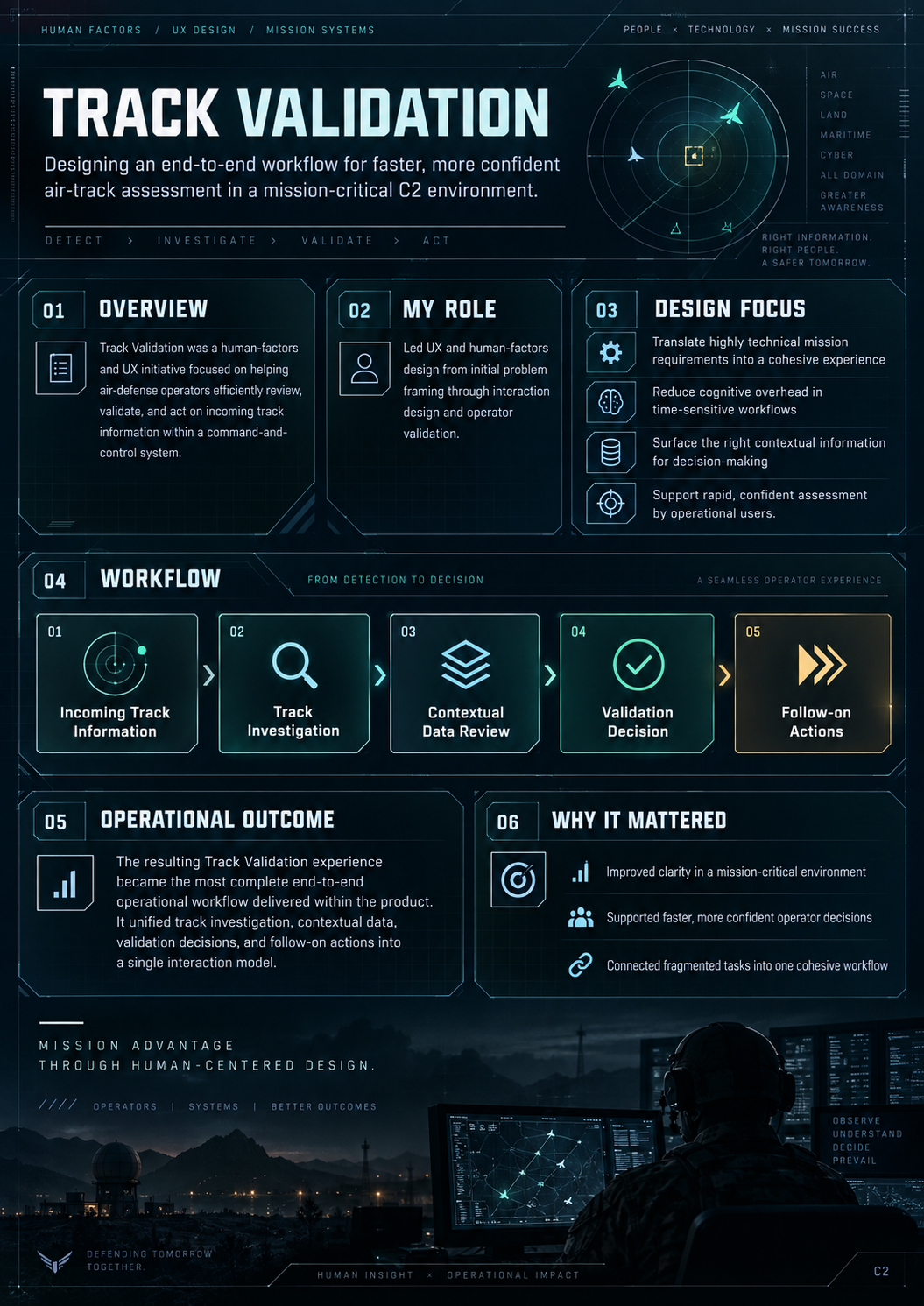
Operators needed to validate air-track information, but the information required to make that call was distributed across a technically complex system. This wasn't a "show more data" problem — operators needed to know what track required attention, why, what was relevant to the decision, what further investigation was needed, and what to do next. Without a cohesive workflow, they risked assembling that context manually while still holding awareness of the broader battlespace — exactly the wrong place to add cognitive overhead.
02Action
I led the problem framing and interaction design for an end-to-end Track Validation workflow: mapping the operational decision process itself rather than treating it as a set of separate screens, determining what information should surface at each stage, and organizing investigation, context, validation controls, and follow-on actions into one continuous experience. I worked directly with weapons officers and operational users to evaluate concepts against how they actually reasoned through validation, and iterated the workflow on that feedback.
The goal throughout: make the system support the operator's reasoning process, instead of forcing the operator to adapt their reasoning to the software.
03Result
- Became the most complete end-to-end operational workflow delivered within the product's scope
- Reduced cognitive overhead during track investigation by unifying context, decision, and action
- Clearer, more direct relationship between surfaced information and required operator action
- Workflow reflected how operators actually reasoned through validation, not an idealized version of it